Speech Delay
The development of speech sounds is a gradual process from babbling, to putting sounds together in words and then sentences. Some children will progress quickly having clear speech from an early age, whilst for others the process will be much slower. Speech delay is a failure to develop speech sounds at the expected chronological age. Below is a diagram highlighting normal speech sound development.
| Age | |
| 3 years | Vowels m n ng p b t d f v s z h w, l, y |
| 3 years 6 months – 4 years | c/k as in cake or kite g as in gate ch as in cheese j as in jug |
| 5 years | sh as in shoe |
| 6 years | r as in rainbow |
| 7 years | 7 years th as in thhumb the as in their |
Here are some typical patterns
| Pattern | Description | Example | Age Overcome |
| Final Consonant Deletion | Missing off final sounds of words | cat → “ca” bus → “bu” | 2 years |
| Voicing | Unnecessary vocal fold vibration or lack of | pig → “big” pig → “pik” | 2 years 11 months |
| Stopping | Making a long sound short | sun → “dun” feet → “beet” | 3 years 5 months |
| Weak Syllable Deletion | Missing out unstress syllable | tomato → “mato” elephant → “ephant” | 3 years 11 months |
| Fronting of Velar | Producing back sounds anteriorly | monkey → “montey” gate → “date” | 3 years 11 months |
| Cluster Reduction | Deletion of 1 consonant when they are together | spider → “pider” green → “geen” | 4 years 11 months |
| Deaffrication | Deletion/miss-production of 1 of 2 sounds present in “ch” and “j” | cheese → “sheese” bridge → bridz | 4 years 11 months |
| Gliding | Replacement of ‘r’ or ‘l’ with “w” or “y” | rabbit → “wabbit” light → “yight” | 5 years 11 months |
What speech errors may sound like?
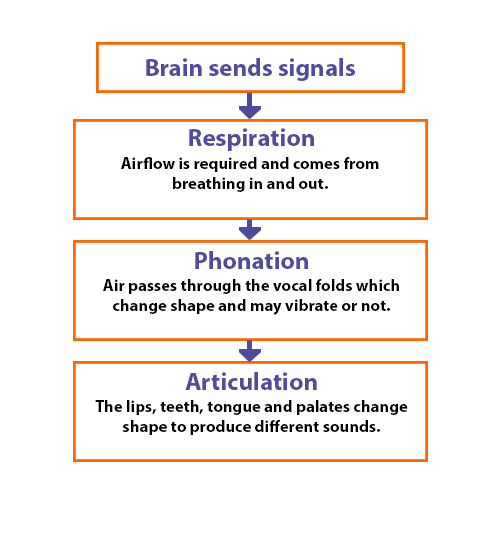
The production of speech is a complex process which involves the physical movement of the lips, tongue, teeth and/or vocal cords. These are called articulators and many children who sound unclear have difficulties at this level. Some children have difficulties producing sounds on their own (e.g. imitating the sound ‘f’). Whilst others have difficulties blending sounds at the beginning, middle and/or end of words (e.g. saying the ‘f’ sound in ‘feet’, ‘elephant’ or ‘knife’) or when using sentences. Children with speech difficulties may demonstrate some of the following:
Speech sound substitutions
This is where a target sound that is difficult to articulate is simply substituted for another sound. For example the ‘f’ in feet can be substituted for ‘b’ making the word sound like “beat”. This is typical for a child until approximately 3 years 6 months and should overcome with maturation. However, if a child older than 4 year and continues to have difficulties articulating the ‘f’ sound this may require some further assistance from a Speech and Language Therapist to ensure the sound develops appropriately and does not have an impact on the child’s self-esteem or literacy development.
Omitting sounds
This is where an individual simply deletes the sound they find tricky from words. For example, if the ‘s’ sound was what the individual found difficult to articulate they might produce the word ‘sun’ “un” and ‘bus’ “bu”. This is known as atypical as it does not follow any developmental norms. The only omission that is known to be typical is that of final sounds however, this is usually overcome by 2 years 6 months.
Combination of Substitutions and Omissions
Some children have extremely unclear speech even when speaking to familiar adults and can demonstrate both sound substitutions and omissions. Some children tend to only be able to produce open mouth sounds such as vowels.
Inconsistent Speech Sound Errors
This is where a child shows no pattern of speech sound errors and the same word can be produced differently on different occasions. This can make it extremely difficult to comprehend what your child is saying.
Developmental Verbal Dyspraxia
In fewer cases children have difficulties with co-ordinating the muscles involved with producing speech this can be due to a breakdown in the brain’s signals to the muscles. Difficulties with the co-ordination of speech is known as Dyspraxia (also known as Apraxia of Speech). See the flow chart on the right for more detail.